
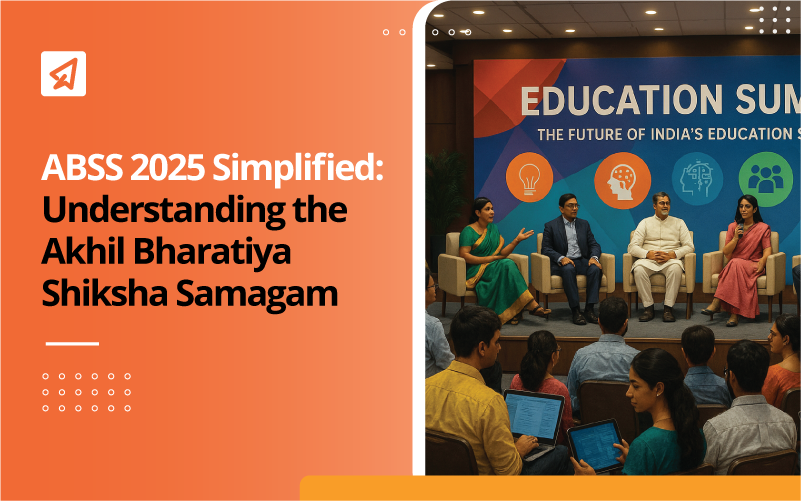
There has been a huge change in the way the Indian education system works since the inception of the National Education Policy, or NEP 2020. One of the most important platforms for reviewing this progress is the Akhil Bharatiya Shiksha Samgam (ABSS). It is an annual national education summit that brings together leaders, educators, policy makers and innovators from across the country.
Akhil Bharatiya Shiksha Samgam plays a very important role and is a road map in India’s education as it traces the implementation of this policy. It encourages collaboration and introduces new initiatives to improve education and higher education.
ABSS 2025 was marked five years after NEP 2020 this year, and the occasion focused on the future direction of India’s learning ecosystem, particularly the progress made so far in areas such as Indian languages, research, technology, and AI in education.
What is Akhil Bharatiya Shiksha Samgam?
ABSS (Akhil Bharatiya Shiksha Samgam) is an All India Education Summit organized by Ministry of Education. It is a national stage to showcase progress, review policies, and discuss new practices in schools and higher education institutions.
Focus on ABSS:
- To review the progress made under NEP 2020
- Encouraging schools and universities to demonstrate teaching methods
- Setting new goals to transform India’s educational landscape
At ABSS 2025, participants celebrated five years of NEP and reflected on the rise of Indian languages, digital tools, research, and AI in classrooms and universities. It also highlighted how far the country has come, and what needs to happen next.
What happened in ABSS 2025?
ABSS 2025 included several sessions, discussions and announcements. Here’s a simple breakdown of everything going on.
Opening session
The program began with a warm welcome, followed by keynote speeches by the Education Minister and other dignitaries. Several new education initiatives, reports and digital platforms were launched to support this NEP Goals. The inaugural session also reviewed India’s Vision 2030 with emphasis on innovation, inclusion and better education.
India’s Education Progress (2020–2025)
ABSS 2025 looked at the milestones that had been achieved since the introduction of the NEP. This progress was covered in school education, higher education, assessment reforms and overall improvement in quality.
School education
Improved Literacy and Numeracy through Nipan Bharat
Nippon India It plays an important role here, helping young learners to consolidate their reading, writing and basic math skills. Schools have reported better basic learning because teachers have adopted more activity-based and child-friendly approaches to teaching.
Upgraded infrastructure under Prime Minister Shri Schools
Many schools across the country have benefited from improved classrooms, Digital Learning Spaces, labs and comprehensive facilities. This upgraded infrastructure has helped the Indian education system keep up with the changing times and proved to the world that India is second to none when it comes to basic or even higher education.
Better nutrition and attendance through Prime Minister Potion
The latest mid-day meal program has made a huge difference in education. With better mid-day meals, students are getting better nutrition, which directly affects their energy levels, focus and overall well-being. As children feel healthier, their attendance naturally increases, and teachers observe much better participation in classroom activities. For many students, this program ensures that they receive at least one balanced meal a day, which plays an important role in supporting learning and sustained school engagement.
Higher education
Flexible learning through the Academic Bank of Credit (ABC).
Academic Bank of Credit has made higher education very flexible for students. Instead of being tied to one institution, students can now earn credits from different universities, store them digitally, and transfer them whenever needed. This freedom gives students the flexibility to choose paths that suit their interests, pace and future goals, making education more personal and accessible.
The rise of online and hybrid courses
In the last five years, universities have opened up a much wider range of online and hybrid learning options. This has helped students who would not be able to attend regular classes on campus due to distance, work or personal commitments. With digital platforms, recorded lectures, and virtual labs, higher education has become more convenient, flexible, and inclusive, giving learners multiple ways to learn wherever they are.
Research enhancement with support from PMRF and HEI
India’s research ecosystem has also been strengthened through programs such as the Prime Minister’s Research Fellowship (PMRF) and collaborations between higher education institutions. These steps encourage students to do preliminary research, especially me The cell Fields. With better funding, guidance, and support, universities are able to mentor young researchers and contribute to India’s scientific and technological progress.
Teacher training and AI awareness
Universities and colleges have also focused heavily on professional development for teachers. Continuous teacher training sessions help faculty stay updated with teaching techniques, curriculum changes and digital tools. A major area of focus has been AI awareness. It has helped teachers understand how artificial intelligence can support the way they teach, assess and contribute. Personalized learning. It benefits both teachers and learners with the latest advancements in education technology.
Assessment and quality
Nationwide surveys like NAS and PARK
Mass diagnostics such as NAS and Park Helped identify learning gaps and improve classroom practices.
Improved quality monitoring through accreditation reforms
The recent NIRF classification and accreditation process has forced institutions to raise their standards.
Thematic Session at ABSS 2025
ABS 2025 included several theme-based sessions that discussed the future direction of Indian education.
Indian Languages in Education
A major focus of the summit was the growing importance of Bharatiya Bhasha in classrooms. Speakers spoke about how the use of Indian languages in education not only improves understanding but also helps students stay connected to their cultural roots. ABSS 2025 also reinforced the need for effective implementation Three language policy So that children develop strong multilingual skills. This change supports better understanding, stronger literacy, and more inclusive education in diverse regions.
Research and innovation
Another important thing to note was the push to stabilize India’s research ecosystem. With programs like PMRF and collaboration between universities, the country is encouraging students to explore scientific, technological and social research more deeply. The summit highlighted the need for better research infrastructure, funding and mentorship so that young researchers can meaningfully contribute to national development and global innovation.
Universal Secondary Education
ABSS 2025 also emphasized on ensuring that every child in India completes secondary education by 2030. This also includes creating a strong support system for rural, tribal and backward classes, where dropout rates are still high. These discussions focus on improving school access, providing financial support, and offering flexible learning pathways so that no student is left behind.
AI in education
Artificial intelligence was another key discussion point, particularly in terms of how it can enhance classroom learning and student learning. Experts explained how AI tools can help personalize lessons, identify learning gaps faster, and help teachers with automated assessment and planning. With AI becoming more common in schools, the summit highlighted the need for careful adoption, teacher training and ethical use. You can find more information about this shift here: AI in education.
New launches and announcements
ABSS 2025 Also introduced several new developments:
- Inauguration of new school and university facilities
- Release of new educational apps, digital platforms, and AI-enhanced tools
- Policy updates supporting research, language learning, and skill development
Panel discussion and knowledge sharing
Experts, teachers, principals, and state level leaders shared their experiences on NEP implementation. They discussed the challenges schools face, success stories, and solutions to improve inclusion, quality, and access to education.
Closing session
The event ended with:
- Summary of key discussions
- Presentation of a “vision document” outlining the next steps for the NEP
- Remarks and thoughtful reflections on the future of education
Side events and exhibitions
The summit also includes:
- Demonstration of best practices from schools and universities
- Workshops on AI tools and digital learning
- Media briefings and networking sessions
- Student-led innovation showcases
Key takeaway from ABSS 2025
ABSS 2025 has brought together India’s academic community to reflect on the achievements of the past five years and plan for the next decade. It reinforces the shared national vision of creating a modern, inclusive, tech-enabled education system based on Indian values and global skills.
The Akhil Bharatiya Shiksha Samgam serves as a powerful reminder of how far India has come since NEP 2020, and how much potential lies ahead. With clear goals, strong collaboration, and continuous innovation in pedagogy, assessment, digital learning, and Indian languages, ABSS 2025 has laid the foundation for transforming education across the country. As teachers, educators, policy makers, etc Edtech partners such as Xtrix Working together, India is closer to an education system that is future-ready, equitable and student-centric.
Last updated on December 12, 2025

Priya Kapoor | AVP – Academics
Priya Kapoor is an education professional with over 18 years of experience in a variety of fields, including elearning, digital and print publishing, instructional design, and content strategy. As the AVP – Education Specialist, she guides the academic teams in developing tailored educational solutions, ensuring alignment with various curricula across national and international platforms…Read more
