
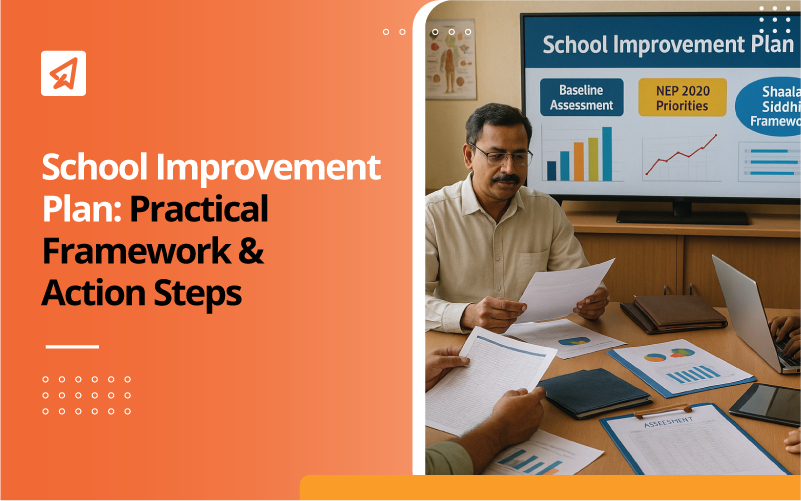
Creating a School Improvement Plan (SIP) is essential for schools that want sustained growth, high learning outcomes, and alignment with national frameworks such as the National Education Policy (NEP) 2020. A strong SIP provides your school with direction, structure, and accountability, helping you move beyond isolated initiatives to measurable, long-term improvement.
This guide walks you step-by-step through how to design and implement an effective School Improvement Plan (SIP) tailored to your school’s needs.
The key path
- A School Improvement Plan (SIP) provides schools with a systematic, measurable, long-term roadmap to improve academics, culture, safety, infrastructure and teaching quality.
- A strong SIP begins with a thorough baseline assessment, stakeholder input, and clearly defined SMART goals that align with the school’s vision.
- Effective SIPs integrate NEP 2020 priorities such as basic education, experiential classrooms, multilingualism, digital literacy, and professional exposure.
- Alignment with the Shala Siddhi framework helps Indian schools conduct evidence-based self-evaluations and track progress in seven key domains.
What is a School Improvement Plan (SIP)?
A school improvement plan (SIP) is a systematic, evidence-based roadmap that describes how a school will enhance its teaching practices, strengthen learning outcomes, improve infrastructure, and create a safe learning environment. It includes clear goals, timelines, responsibilities, evaluation criteria and measurable indicators of progress.
A SIP ensures that improvement is neither random, reactive, nor dependent on individual leadership. It should be organized, consistent and school-wide.
School Improvement Plan (SIP) and Shala Siddhi
While drafting a School Improvement Plan (SIP), Indian schools should consider the Shala Siddhi Framework, an initiative under NIEPA (National Institute of Educational Planning and Administration) that sets national standards for school evaluation and improvement. We will cover more of its importance in this blog.
Aligning your SIP with NEP 2020: What schools should not miss
Your School Improvement Plan (SIP) should be natural Align with the priorities outlined under NEP 2020especially as Indian education moves towards competency-based, technology-driven, and inclusive education.
NEP 2020 integration areas to include in your SIP:
- Basic Education: Prioritize strong literacy, numeracy and theoretical understanding in the early grades.
Read more: Basic education
- Multilingual/Native Language Instruction: SIP goals should reflect early learning and gradual transition to local languages Multilingual ability.
- Experiential learning: Encourage hands-on activities, real-world application, labs, games, arts, and project-based learning.
Read more: Experiential learning
- Digital literacy for all students: Make sure every child has access to technology, digital tools, and better learning resources.
- Professional Integration: Add structured exposure to craft, skills, entrepreneurship, and community-based learning.
Read more: Vocational education
Incorporating these elements strengthens the relevance of the SIP and ensures alignment with national policy outcomes.
How to Create a School Improvement Plan (Step by Step)
Below is a complete process that schools can follow to design an actionable, holistic school improvement plan (SIP).
Step 1: Do a thorough assessment of the school
Before writing any goals or plans, you need a baseline, a clear understanding of where the school currently stands.
Why baseline assessment is important:
It helps you:
- Identify strengths and gaps.
- Prioritize areas for improvement.
- Set realistic and measurable goals.
- Create a data-backed SIP instead of a guess-based one.
Use a variety of assessment tools:
A high-quality assessment includes:
- School Audit (Education, Security, Infrastructure, Digital Readiness)
- Surveys for teachers, parents and students
- Classroom observations
- Infrastructure inspection
- Analysis of attendance, test results, and student behavior
- A review of community engagement practices
- Digital readiness and access to technology check
Your evaluation should cover academics, infrastructure, safety, culture, teacher performance, leadership, and community involvement.
Step 2: Engage stakeholders for input and support
A school improvement plan (SIP) is only successful when everyone involved feels ownership. Ensure that key stakeholders, such as teachers, students, parents, administrators, etc School Managementparticipate in the process.
Why stakeholder participation matters:
- It promotes trust and transparency.
- You get a broader perspective and on-the-ground insight.
- This increases community support during implementation.
How to add them:
- Conduct focus groups with parents.
- Organize student council discussions.
- Hold a teacher roundtable.
- Set up a digital suggestion box.
- Use forums and feedback loops as appropriate Communication and collaboration.
Step 3: Define clear goals and measurable objectives
After collecting the necessary data and engaging with the necessary stakeholders, you need to translate your findings into smart goals.
- Specific: Improve the reading level of class 3.
- Measurements: Increase reading skill from 45% to 70%.
- Achievable: Align with available staff and resources.
- Related: Matches NEP priorities (basic literacy).
- Time bound: Get it by the end of the school year.
Types of school improvement plan (SIP) goals to include:
- Short-term quick wins such as painting classrooms, restructuring timetables, and staff orientation.
- Long-term strategic goals such as improving NEP-aligned classrooms, upgrading labs, and increasing community participation.
Your action plan for a school improvement plan (SIP) should clearly outline the purpose, expected outcomes and measurable goals.
Step 4: Develop an action plan with roles and responsibilities
Once the goals of your school improvement plan (SIP) have been finalized, it’s time to turn them into actionable steps.
For this, each action plan step should include:
- What needs to be done?
- Who is responsible?
- Resources are needed
- Time line
- Indicators of success
- Reporting Procedures
Schools can maintain SIP dashboards or spreadsheets to monitor schools.
Step 5: Integrate key focus areas effectively
Your School Improvement Plan (SIP) is strengthened when it identifies the most important pillars affecting school performance.
- School Culture: A positive school culture improves learning, behaviour, retention and staff wellbeing.
Read more: How to improve school culture
- Infrastructure: Modern, secure infrastructure enhances teaching effectiveness and student engagement.
Read more: Key infrastructure needs of the school
- Student Safety: Include fire safety, transport audits, CCTV coverage, visitor logs, and mental health practices.
Read more: Measures to protect students in school
- School Audit: Schedule an annual or biannual audit to assess progress and identify new gaps.
Read more: School Audit
- Technology and Pedagogical Innovation: Digital tools, blended learning, AI insights, personalized learning resources, and empowering teachers.
Read more: School improvement ideas
Step 6: Align your sip with the Shala Siddhi framework
Shala Siddhi ensures your School Improvement Plan (SIP) adheres to India’s National Standards for School Improvement.
Why this step is important:
- Encourages evidence-based improvement.
- Supports transparent reporting.
- Allows benchmarking with national indicators.
- Ideal for CBSE, State Board, Rural and Private Schools.
Seven domains to cover:
Shala Siddhi provides a seven-domain framework that forms the backbone of structured school evaluation.
| Shala Siddhi Domain | What does it cover? |
| Activating resources | Infrastructure, digital access, and amenities |
| Teaching learning and assessment | Instructional, assessment standards, and classroom practices |
| Learner Progress | Educational Outcomes and Inclusive Development |
| Teacher performance | Qualifications, training, and professional development |
| Leadership and management | School leadership, decision-making, and governance |
| Inclusion, health and safety | Safety and hygiene |
| Community participation | Parent and community involvement |
Schools should use the eSimixa dashboard for structured self-evaluation, uploading evidence, tracking improvement milestones and generating reports.
with the Extra Marks’ From the analytics dashboard, you can map student performance, assessment, attendance, teacher progress, and engagement data, and align your School Improvement Plan (SIP) with Shala Siddhi domains to simplify SIP reporting and support data-driven decisions.
Step 7: Implement monitoring and evaluation processes
A school improvement plan (SIP) is only effective if progress is tracked consistently. Below are the essential elements to monitor for optimal results:
- Monthly review meeting
- Teacher development reports
- Analysis of learning outcomes
- Student behavior and attendance data
- Classroom observations
- Parent feedback loop
Best Practices for Assessment:
- Use dashboards or simple tracking sheets.
- Share periodic updates with staff and parents.
- Adjust strategy based on progress and feedback.
- Celebrate improvement to keep teams motivated.
Step 8: Foster a culture of continuous improvement
A sip is not a one-time document. You have to make it a part of your framework for smooth functioning of the school.
To maintain long-term success:
- Encourage experimentation with teaching techniques.
- Promote ongoing teacher training.
- Keep updating SIP targets based on new challenges.
- Prioritize teaching reforms linked to NEP 2020.
- Celebrate milestones to keep spirits up.
A culture of continuous improvement ensures that your School Improvement Plan (SIP) does not remain on paper but transforms everyday learning.
The result
A robust School Improvement Plan (SIP) helps Indian schools achieve structural growth, measurable learning outcomes and long-term sustainability. By aligning SIP goals with NEP 2020, Shala Siddhi, and evidence-based school audits, and by engaging stakeholders, setting SMART goals, and leveraging technology, schools can create an environment where students, teachers, and communities thrive together.
Frequently Asked Questions
School leadership usually guides the SIP creation process, but teachers, parents, students, and community members should be actively involved to ensure relevance and collective ownership.
SIPs should be updated quarterly and annually. Big goals can span 2 to 3 years, but progress should be reviewed regularly.
Key components of SIP in education are evaluation, stakeholder engagement, SMART goals, action plans, key focus areas, alignment, monitoring and continuous improvement methods.
Technology supports personalized learning, digital records, analytics dashboards, online assessments, and teacher efficiencies, which reinforce SIP implementation.
ExtraMarks provides data dashboards, performance insights, digital learning tools, and classroom analytics that help schools track progress, align with Shala Siddhi, and make evidence-based decisions.
Precise SIPs help rural and small schools prioritize resources, improve instructional practices, align with NEP 2020, and increase community involvement.
Last updated on December 16, 2025

Priya Kapoor | AVP – Academics
Priya Kapoor is an education professional with over 18 years of experience in a variety of fields, including elearning, digital and print publishing, instructional design, and content strategy. As the AVP – Education Specialist, she guides the academic teams in developing tailored educational solutions, ensuring alignment with various curricula across national and international platforms…Read more
