
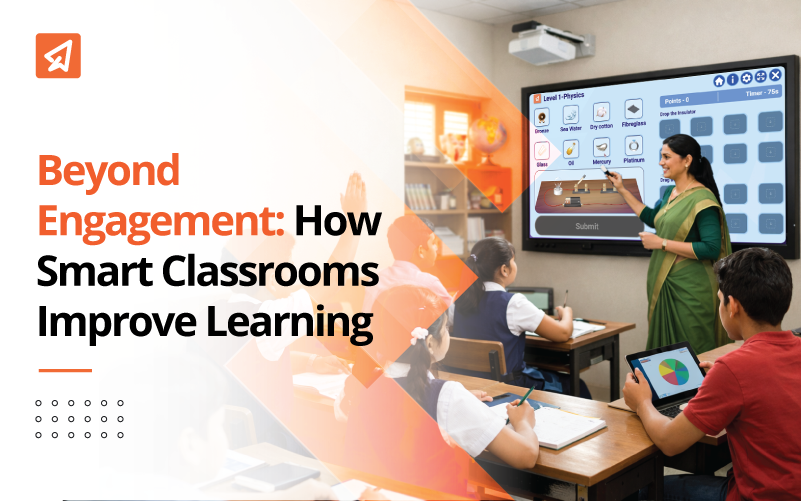
Many schools in India have already adopted smart classrooms. But that’s not what this blog is about. While schools are more open to smart classrooms due to increased digital adoption, the real burning question remains: Are students actually learning better because of them?
This blog focuses on the learning outcomes of smart classrooms and how they make a measurable difference when implemented with the right educational focus.
Related Read: Benefits of Smart Classrooms
What do learning outcomes mean?
Before we begin, let’s first understand what we mean by “Learning outcomes“of Smart Classrooms.
Learning outcomes refer to what students are actually able to understand, remember and apply after learning a subject. These findings help schools assess whether teaching methods are working beyond superficial engagement.
Strong learning outcomes answer questions such as:
- Do students understand the concepts clearly?
- Do they perform better on assessments and exams?
- Do they retain what they learn over time?
- Do they develop skills they can apply beyond textbooks?
When schools focus on outcomes, learning becomes measurable, meaningful and sustainable.
How Smart Classrooms Improve Student Learning Outcomes
Smart classrooms impact learning outcomes by improving the way students absorb, process and apply knowledge. When used with a learner-first mindset, they support better comprehension, retention and academic performance without relying on memory.
Gives timely feedback.
Timely feedback plays an important role in improving learning outcomes. When students receive feedback during the learning process, they are able to correct errors in time. They can identify their mistakes quickly, which helps them quickly refine the learned concepts in their minds.
Meets a variety of learning needs.
Every classroom includes students who learn at different speeds and in different ways. Smart classrooms support diverse learning needs by allowing students to engage with concepts at their own pace.
When learning is tailored to individual comprehension levels, comprehension improves throughout the classroom. This inclusion leads to more consistent learning outcomes, ensuring that slow learners are supported while advanced learners continue to progress.
Encourages applied learning.
For students to learn effectively, their learning must extend beyond the curriculum. And smart classrooms encourage this through applied learning, which helps students connect concepts to real-world situations. This approach strengthens their critical thinking and problem-solving skills, moving students beyond memorization.
As a result, they have a deeper understanding of the concepts they learn and long-term academic preparation.
Improves visualization skills.
When students interact with concepts instead of passively consuming information, cognitive engagement increases significantly. This deep processing strengthens conceptual skills, leading to measurable improvements in comprehension and evaluation performance. Smart classrooms support students in this active learning process.
Supports knowledge retention.
Learning through multiple formats strengthens memory formation. When students learn concepts through auditory, visual, and written explanations, their information recall skills improve over time. This repeated exposure to different learning formats increases long-term retention, which supports test performance and continued learning progress.
How to check if smart classrooms are improving learning outcomes
Schools can assess whether smart classrooms are delivering desired learning outcomes by using simple, outcome-focused indicators rather than assumptions. Here are some pointers you can track:
- Student test scores to measure academic improvement: Better scores mean smart classrooms are doing their job.
- Subject-level understanding through formal assessment: Assessments are the best way to check whether students are actually retaining the information learned and applying it to practical situations.
- Attendance patterns to assess classroom effectiveness: If students enjoy what they learn in class, attendance rates are going to be high.
- Homework completion to assess learning continuity: Teachers should check student homework to better assess their knowledge and retention of information.
- Periodic reviews to identify weak areas and improve teaching strategies: Teachers should conduct regular review sessions for students. Based on this, they can also figure out how to improve their teaching strategies.
How Xtramarks helps schools achieve better learning outcomes
Platforms like ExtraMarks SmartClass Plus help schools by consolidating teaching, practice, and performance tracking into a connected ecosystem. We help your schools consistently improve learning outcomes by aligning your classroom instruction with assessment insights and continuous improvement.
Don’t believe us? See what current Extramarks customers are saying:
The result
Smart classrooms aren’t just about screens or infrastructure. They are about improving the way students learn, understand and retain knowledge. Schools that focus on outcomes rather than tools are the ones that see meaningful, long-term improvements in learning outcomes!
Published on February 16, 2026.