
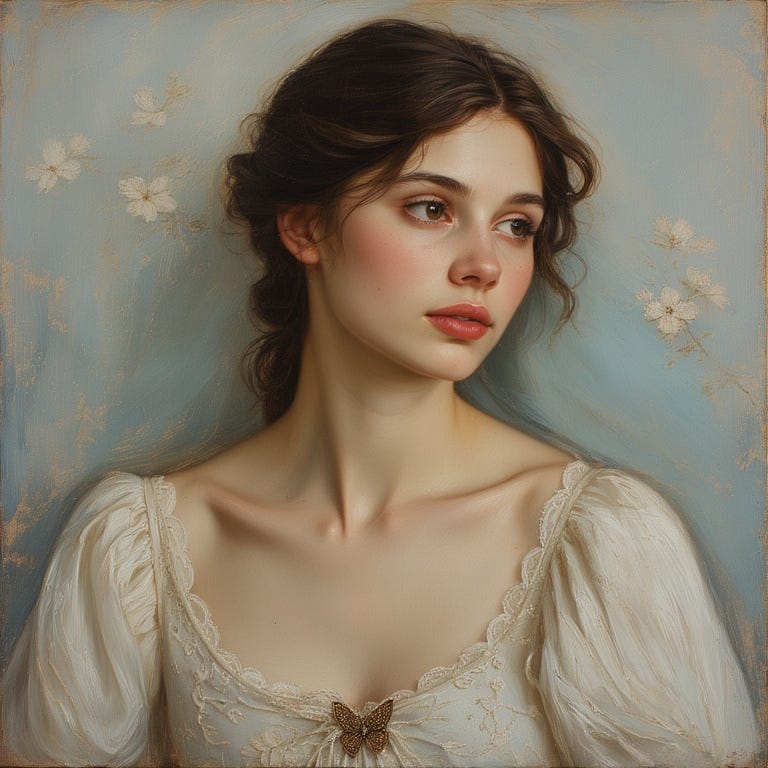


Thinking about effort, presence and meaning in a time when images appear faster than thought.
I look at a picture I made in five seconds. I like it. Two centuries ago it would have passed as a venerable painting. Today it feels like a pleasant image that arrived at the command. I didn’t fight for it. I did not sand the edges with the pencil. Something is, and something is gone.
When the effort is silenced
I used to sit with a pencil without a plan. A small spark was enough. Time dissolved. Paper pushed back. The wrist received a rhythm. The last millimeter of a shadow matters.
Now I write a sentence and a picture appears. It may be cute, yet my mind doesn’t register the same satisfaction. Why?
- The try-reward loop is missing. In the drawing you collect many small wins. A curve eventually behaves, a plane bends with tone, an edge breathes. Every success gives a little burst of happiness. The loop collapses in one click with instant results. There is no ladder to climb.
- The value of time anchors. Six hours on paper teaches that the image holds your hours, so the mind values it. Send an anti-signal for six seconds. Speed reads as understated.
- Touch creates reality. Paper has grain, graphite has weight, gives sound and friction feedback. The body remains involved, the focus remains embodied. Pure text feels abstract. You don’t realize where you are at work.
- Agency feels thin. When a system fills in too many details, authorship can feel clunky. You are more than a director. The shift is real and calls for a new ritual.
- Flow requires challenge. Flow occurs when skill meets difficulty. If the problem goes away, the focus is heightened and the mind doesn’t enter that quiet, rewarding tunnel.
The technique proved once intended. Now the intention needs its skill. The role changes. Instead of pushing the pigment, you create a scene, an emotion, and a frame. You choose the light, the distance, the palette, the rhythm. The hand moves less. The focus should shift more. This is not a rejection of the hand, it is a move to the heart of the process. The question becomes simple: what should the image say, and how do I guide an instrument to say it without losing the feeling that started me?
Can a painter write like a poet?
Quick sentences often sound dry. Realistic face holes. Sharp focus. Equilibrium People don’t think in checklists, we think in little stories. We remember the warmth on one cheek and a smile that sits at the corner of the mouth.
There is a way. Write the scene as first person. Then translate.
A small example. A plump, slightly Hollywood cat sits in a clearing in a bright and colorful forest, eyes closed, a calm smile on its face. On his head, a huge mushroom cap like hat. Sunlight filters through the leaves and protects it.
This is the live version. From this you can extract the parts that the tool can work on:
- Topic: Bold Cat, Subtle Anime Effect, Sitting
- Key Prop: A giant mushroom cap worn as a hat
- Location: Summer forest clearing, colorful vegetation
- Light: Faded sunlight, soft beams through the leaves
- Mood: Peaceful, Warm, Storybook
- Style: Painterly, soft, fantasy illustration
First feel the scene, then translate.

Fantasy illustration, soft painterly style, subtle anime influence, storybook vibe. A sunny anime-style cat sitting calmly on a clearing in the sunlight forest, eyes closed with a slight smile, wearing a large mushroom cap hat, surrounded by colorful colorful forest, dimming the sunlight through the leafy trees. Hot and magical summer atmosphere, light rays, surreal atmosphere. Shallow depth of field.
What these systems read and what they remember
These systems map language to visual patterns they have seen with similar topics. Clear objects and ties work well. A fat cat works. A mushroom cap works. A cat works under a mushroom hat. The phrase “a hat that harbors his dreams” doesn’t work. Dreams have no visual anchor.
Modern checkpoints analyze relationships better than early ones. They follow who wears, who is in front, which dictates the distance of the lens. They respond to lighting conditions and general style labels. They still struggle with layered metaphors and indirect speech. Long chains of abstract instructions are a blur in general production.
If you want a specific result, name the objects, the relationships between them, lighting, color range, distance, mood, and a stylistic cue or two. Keep the summary as spice, not the core.
Why sharp photos can feel empty
Speed eliminates friction. Friction trains attention. Focus is where meaning grows. When nothing resists you, you glide on the surface of your idea, and the image doesn’t change you when you create it. The picture arrives, but your mind hasn’t traveled.
You can restore depth by restoring time and selection.
- Sit with the thought. Write three lines of mode ; No jargon.
- Sketch the scene with five nouns and five verbs. The cat sits. The sun breaks. Leaves flicker. Hat shelters. air shine.
- Choose brightness, color range and distance. close or wide; hot or cold; hard or soft
- Generate once. Don’t chase perfection. See what the image is trying to become.
- Adjust one axis at a time: subject, lighting, palette, composition. Don’t change everything at once.
- Keep a brief log of decisions. For your memory, not for the machine.
- When the image becomes complex, start breathing instead.
Maybe if we allow ourselves to stop, the path to the image can still be slow. to invent. Write to work again. to listen to music. Choosing the right lighting. To find that one word that will suggest the scene. Don’t press and receive, but feel and reflect. The goal is not immediate output. The goal is to get your brain moving.
A small map for the language
- Objects before adjectives: cat, hat, forest, light; Then features
- The relationships are clear: cat wearing cat ; Sun through the leaves; Beam on fur
- Light words carry weight: dappled, rim light, cloudy, golden hour. Select one.
- Guides rendering style: painterly, storybook, watercolor, cinematic; One or two, not a list.
- Mood is related in simple words: calm, playful, fistful. The system will not paint the word, but it will advance your selection.
- Keep summary lines in your notes. Bring only what you need in the last line.