
Over the past year, Google has significantly stepped up its investment. Artificial Intelligence and Machine Learning on its products and platforms. While most marketers are familiar with ChatGPT, Google has been advancing its AI capabilities in parallel, including the relaunch of Bard as Gemini and the steady rollout of AI-powered features on Google Play.
For app marketers and ASO experts, these developments are not abstract. They represent a fundamental shift in how apps are perceived, categorized and presented to users. Google Play is no longer relying primarily on keyword matching. Instead, it’s moving toward a deep, meaningful understanding of apps, their functionality, and the problems they solve.
This evolution raises an important question. If Google rapidly generates, interprets, and evaluates app metadata, how do ASO teams maintain control, differentiation, and long-term competitive advantage?
A less-used answer lies in a tool that’s been around for years but is rarely discussed in an ASO context: Google Natural Language.
Key takeaways
- Google Play is moving away from keyword density to semantic understanding powered by machine learning and natural language processing.
- Google Natural Language provides valuable insight into how Google interprets app metadata, including entities, sentiment, and category relevance.
- Optimizing for category confidence and entity relevance can improve keyword coverage and flexibility during algorithm updates.
- ASO teams that align metadata with user intent and natural language patterns are better positioned for long-term discovery performance.
- Using tools like Google Natural Language helps future-proof ASO strategies as automation and AI-powered ranking signals continue to proliferate.
Why Traditional ASO Signals Are Losing Impact
Before exploring how Google Natural Language can support ASO, it’s important to understand the broader changes to Google Play’s ranking algorithm.
Over the past two years, Google Play has moved away from an iterative algorithm to a more continuous learning model. While ASO teams still see volatility, it’s now driven less by discrete updates and more by ongoing recalibration as models gather new behavioral, linguistic and performance data. Reindexing events still occur, but they are increasingly associated with semantic reevaluations rather than simple metadata changes.
At the same time, the effectiveness of traditional optimization levers such as keyword density, exact match repetition, and strict keyword placement continues to decline. These tactics are no longer consistent with how Google Play evaluates compatibility.
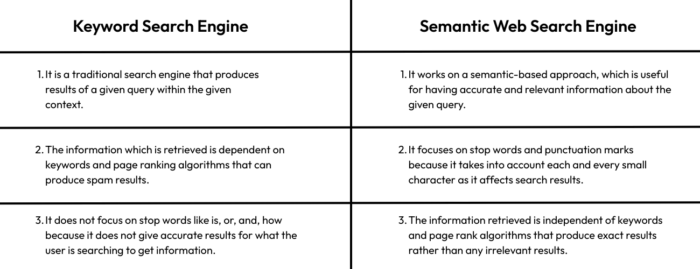
Like Google Search, Google Play is now strongly optimized for meaning rather than mechanics. Its system is designed to understand intent, function and audience context rather than relying on surface-level keyword signals. Algorithms are capable of quickly identifying what an app does, who it serves, and the problems it solves, even when those ideas are expressed using diverse, natural language.
This is where natural language processing becomes the core of modern ASO tools and methods.
What is the purpose of Google Natural Language?
Google Natural Language is designed to help machines understand human language in a way that more closely mirrors human interpretation. It powers a wide range of Google products and capabilities, including sentiment analysis, entity recognition, content classification, and contextual understanding.
In practical terms, it analyzes a body of text and identifies:
- Overall sentiment and tone.
- Key entities and their relative importance.
- The categories and subcategories with which the content is most strongly aligned.
For ASO teams, this presents a rare opportunity. Rather than predicting how Google might interpret app metadata, it provides a proxy for understanding how Google’s machine learning systems read and classify text.
Used correctly, it can help ASO experts align metadata more closely with Google’s evolving ranking logic.
How Google Natural Language Applies to ASO
When applied to app metadata, Google Natural Language can show how Google can associate an app with specific concepts, categories, and keyword themes. This insight is especially valuable as keyword density becomes less influential and semantic relevance is prioritized.
Below are the main components that are most important for ASO.
Sentiment analysis
Sentiment analysis assesses the emotional tone of a piece of text and classifies it as positive, negative or neutral. Although sentiment is not a primary ranking factor for app discovery, it provides useful contextual information.
For example, overly promotional, offensive, or unclear language can add noise to the metadata. Evaluating emotional outcomes can help teams ensure that explanations maintain a clear, unbiased, and informative tone that supports both user confidence and algorithmic interpretation.
Identity and Salvation
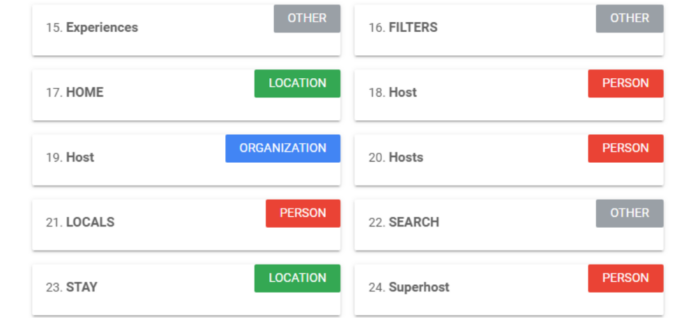
Entity recognition identifies specific entities within text and categorizes them into predefined categories such as company, product, feature, or concept. Each entity is assigned a saliency score, which reflects how central that entity is to the overall content.
In the ASO context, entities may include:
- Main features of the app
- Functional use cases
- Industry specific terms
- Identifiable product or service concepts
Salience scores range from 0 to 1.0. Higher scores indicate that an entity plays a more important role in explaining the content.
From an optimization perspective, this is important. If key features or use cases aren’t appearing very prominently, it suggests that Google isn’t aligning the app strongly with those concepts.
Strategically adding relevant entities to metadata in a natural, user-centric way can improve clarity and strengthen contextual relevance. Placement also matters. Important entities that appear early in the description or are reinforced at the end of the text are given more weight.
Categories and confidence scores
Category ranking is arguably the most influential factor in Google Natural Language for ASO.
When text is analyzed, it assigns it to one or more categories and subcategories, each associated with a confidence score. These scores indicate how strongly the content aligns with a given category.
For Google Play, this has big implications. Higher category confidence increases the likelihood that the app will be associated with a wider range of relevant search queries within that category. Instead of ranking for a narrow set of precise keywords, apps can gain visibility into a broader semantic keyword space.
In practice, we’ve seen that improving category confidence can significantly increase keyword coverage and ranking stability, especially during periods of algorithm change.
To increase category confidence:
- Use clear, natural language that reflects the user’s true intent.
- Focus on describing functionality and value, not just features.
- Avoid keyword stuffing or forced sentences.
- Reinforce category-related concepts consistently throughout the metadata.

Applying GNL insights to metadata strategy
The real value of Google Natural Language is not in isolated analysis, but in iterative optimization. By repeatedly testing metadata drafts through Google Natural Language, ASO teams can refine the language until category confidence, entity integrity, and overall clarity improve.
This approach aligns well with broader 2026 ASO best practices, which emphasize:
- User intent on keyword lists
- Semantic relevance over repetition
- Long-term stability over short-term gains
Case Study Insights
We have applied GNL-powered optimization techniques to several app categories. While the results vary by vertical, the overall pattern has been the same.
During major Google Play algorithm updates, apps optimized around category trust and entity relevance showed greater flexibility. In many cases, visibility improved despite large fluctuations elsewhere in the store.
In one instance, keyword coverage expanded substantially following metadata updates that increased confidence in both the primary category and secondary related categories. This translated to a more than fivefold increase in organic Explore installs over time.
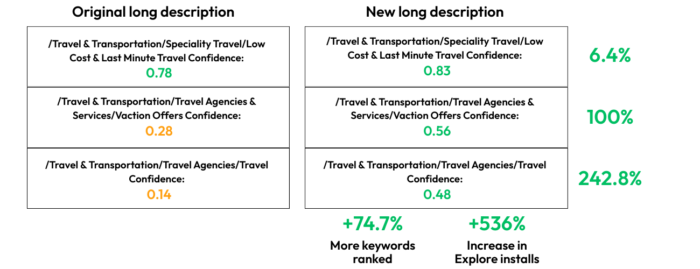
These results reinforce an important principle. When ASO strategies align with how Google understands language, they are better positioned to disrupt algorithmic evolution rather than exploit it.
Integrating GNL into the 2026 ASO Strategy
Looking ahead, the role of natural language processing in app discovery will only grow. As Google continues to automate the creation and interpretation of metadata, manual optimization will shift from mechanical execution to strategic guidance.
ASO teams that understand and leverage tools like Google Natural Language will be better equipped to:
- Guide rather than react to AI-generated content.
- Maintain differentiation in an increasingly automated ecosystem
- Create metadata that supports both paid and organic discovery.
This approach complements broader trends such as AI-powered search, cross-platform discovery, and a privacy-first measurement framework.
The result
The addition of natural language processing does not signal the end of ASO. Instead, it marks a change in how reform should be approached.
By moving beyond keyword density and embracing semantic relevancy, ASO teams can align more closely with Google’s evolving algorithm. Google Natural Language offers a practical way to understand how app metadata is interpreted and how it can be optimized to support discovery, conversion, and long-term stability.
As automation continues to spread throughout Google Play, teams that understand the systems behind it and adapt their strategies accordingly will succeed. Natural language optimization is no longer optional. This is becoming the main pillar of modern ASO.