
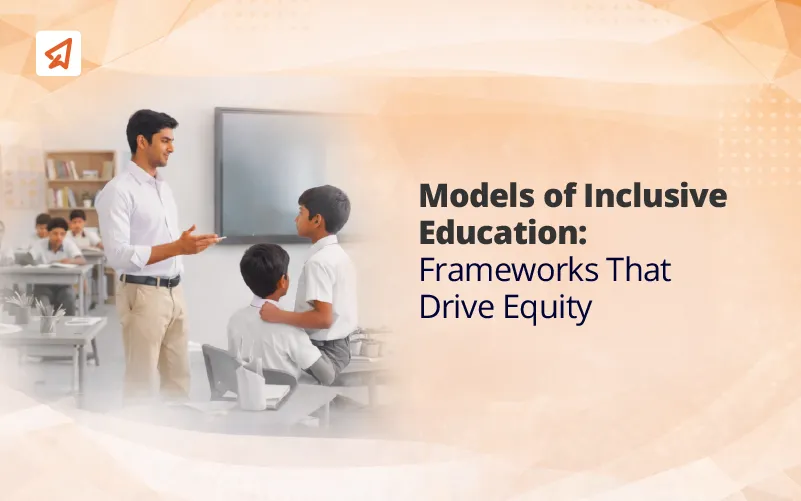
Modern education systems expect schools to diversify learning by providing for learners from all backgrounds, abilities and socio-economic contexts. A uniform approach no longer works in modern classrooms. Schools should adopt structures that ensure meaningful participation for every learner.
And that’s why inclusive education models exist. They provide practical ways to effectively implement inclusive education in a variety of school settings.
What are inclusive education models?
Inclusive education models are structural approaches that guide how schools integrate students with diverse needs into mainstream classrooms. These frameworks help educational institutions decide how teaching, assessment and support services should be organized to ensure participation and equity.
In India, the shift towards Comprehensive education has reinforced the need to understand these models and their practical implications.
The implementation of NEP 2020 has further accelerated the transition towards inclusive schooling.
NEP 2020 and its strong commitment to inclusive education:
NEP 2020 Emphasizes creating inclusive educational institutions that cater to learners from all socio-economic and ability backgrounds.
The policy changes inclusion from admission-based access to equal participation in all academic and co-curricular activities. It also emphasizes. Teacher training and building institutional capacity to effectively implement inclusive education models.
Key provisions of NEP 2020 that support inclusive education
The policy outlines specific initiatives that strengthen the inclusive education model in India.
- Socio-Economically Disadvantaged Groups (SEDGs): The NEP identifies SEDGs and recommends targeted support mechanisms to reduce educational disparities and strengthen access.
- Rights of Persons with Disabilities (RPwD) Act: The RPwD Act reinforces legal safeguards and accessibility standards, ensuring that inclusive education models are aligned with a rights-based framework.
- Gender Identity Recognition: The policy promotes a safe and inclusive environment for all gender identities, ensuring equal participation.
- Establishment of Special Education Zones: Special Educational Zones have been proposed to improve accessibility and infrastructure in these areas.
Major models of inclusive education
Understanding the different models of inclusive education allows schools to choose the framework best suited to their infrastructure, student profile, and teacher capacity.
Full Involvement Model
In a full inclusion model, all students learn together in the same classroom setting with the necessary support services provided. This approach fully integrates learners regardless of disability.
Advantages: Promotes connectedness, reduces stigma, and strengthens peer support.
Challenges: Significant training and structure of teachers is required. Classroom management.
Partial involvement (pull-out) model
Under this model of inclusive education, students attend general education classes for part of their day and are then “pulled out” to special classes to receive separate, specialized instruction for specific subjects.
Advantages: Provides focused intervention without permanently isolating students.
Challenges: If not managed carefully, can create unintended dissociation.
Push-in/co-teaching model
Also known as the team teaching model, this approach involves general and special education teachers working together in the same classroom to learn, plan and deliver shared content.
Advantages: Encourages professional collaboration and diverse instruction.
Challenges: Planning time and shared accountability are required.
Wang’s Adaptive Learning Environment Model
Wang’s Adaptive Learning Environment Model (ALEM), developed by Margaret Wang, is a comprehensive framework that ensures that special education is integrated into mainstream classrooms. This framework helps prevent prejudice and reduce stigma, ensuring that children who need special educational support are not left behind.
It emphasizes adapting instruction, curriculum design, and classroom environments to meet the individual needs of learners within heterogeneous groups.
Advantages: Encourages personalized instruction and adaptive curriculum structure.
Challenges: Differentiation demands constant supervision and teacher expertise.
A strategic intervention model
This model is an evidence-based framework designed to help struggling learners and individuals with learning disabilities succeed in general education classrooms. It is equipped with structured learning strategies and content enhancement routines to support both students and teachers.
Advantages: Strengthens academic performance, builds self-regulation skills, and supports inclusion in mainstream settings.
Challenges: Sustaining effectiveness requires trained educators, consistent implementation, and systematic monitoring.
Scope of the Inclusion Model
This inclusive education model encourages classmates to actively support each other, so students with diverse needs learn together with their peers and are not isolated. It builds inclusion through peer collaboration, shared classroom responsibility, and structured group support.
Advantages: Builds empathy and community participation.
Challenges: Systematic facilitation is needed to avoid unequal participation.
The reverse inclusion model
In this model, general education students attend special or self-contained classrooms designed primarily to support students with disabilities. This environment can create a more comfortable and structured learning environment for students with learning difficulties.
Advantages: Encourages the development of mutual understanding, friendship, empathy, and social skills.
Challenges: Careful resource planning and parent communication is required.
How Extra Marks Strengthens the Implementation of Inclusive Education
Making your classroom inclusive according to patterns of inclusion requires more than good intentions. You need structured tools that support differentiation, early intervention, and measurable progress. Xtramarks provides a technology-driven ecosystem that helps institutions operate inclusive education models in practical, scalable ways. Here’s how:
- Personalized Learning Paths: Extramarks supports differentiated instruction through flexible lesson design tools and adaptive practice models. Teachers can assign content based on individual readiness levels, making it easier to implement different models of inclusive education within mixed-ability classrooms while aligning with NEP’s competency-based approach.
- Data-driven identification of learning differences: Detailed performance analytics allow teachers to quickly identify gaps and provide targeted interventions.
- Structured support for teachers: from AI-assisted lesson planning In ready-made assessment banks, Extra Marks reduces the teaching burden on teachers.
- Real-time progress monitoring and feedback: Continuous assessment features help schools track growth patterns and adjust strategies accordingly.
- Enhancing Equity Through Technology: By providing accessible digital content and adaptive learning pathways, Extramarks helps schools implement inclusive education models across diverse socio-economic contexts in India.
The result
Effective models of inclusive education are essential to building equitable education in India.
Understanding these models, along with the legal and policy frameworks that guide them, empowers educators to design classrooms that truly accommodate diversity.
Frequently Asked Questions
Inclusive education models promote participation, reduce stigma, and provide appropriate support. They help students develop academic, social and emotional skills while fostering a collaborative learning environment.
Schools can implement the inclusive education model in India by investing in teacher training, adopting adaptive technology tools, strengthening assessment systems, and aligning policies with NEP 2020 guidelines.
Schools may face resource limitations, inadequate training, complexity of classroom management, and infrastructure gaps when applying disability models in inclusive education. Strategic planning and technology integration can overcome many of these barriers.
Published on March 30, 2026.