
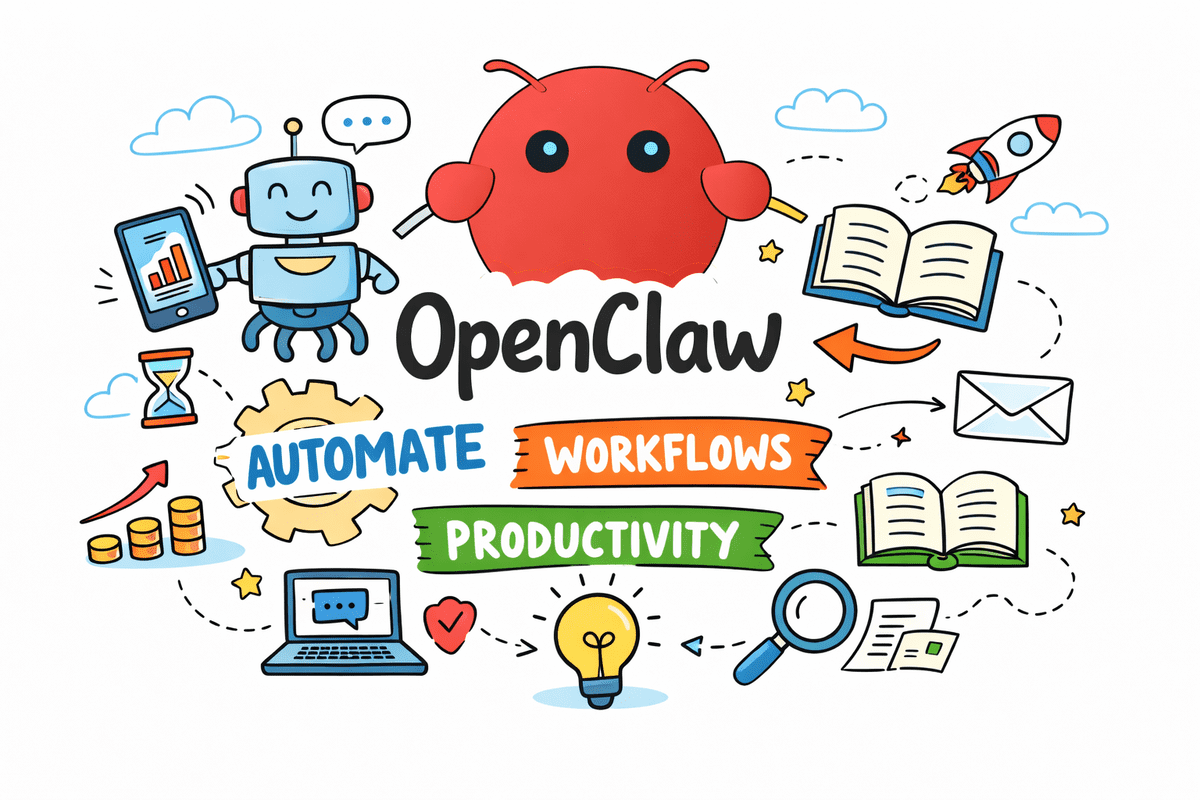
Photo by author
# Introduction
Open Claw It is fast becoming one of the most talked about open source agent systems at the moment. But beyond the hype, the real question is simple: What are people actually using it for?
At its core, OpenClaw helps turn AI into something you chat with that can actually work for you. It connects messaging apps, tools, memory, automation, and agents into one system, so instead of jumping between platforms all day, you can start from the places you already use, like Telegram, WhatsApp, or Discord.
In this article, we look at seven practical ways people are using OpenClaw to automate tasks, stay organized, and increase productivity with real agent workflows.
# 1. Finance and Trading Bots
One of the most interesting use cases for OpenClaw is finance and trading bots powered by the latest large language models (LLMs).
People are using it to monitor market news, track price moves, follow social sentiment, and get useful updates sent straight to their phones. Instead of checking multiple dashboards and feeds all day, OpenClaw can help pull everything into one ongoing workflow.
With the new LLMs, these bots can do more than just send alerts. They can summarize signals, compare sources, and highlight why something is important—making market research faster and more useful.
Showcase Link: Polymarket Autopilot.
# 2. Remote coding and dev workflows
Another big use case is remote development.
People are using OpenClaw to send instructions to coding agents, run tasks on their machine, edit files, solve problems, and manage workflows even when they’re away from their laptops. This means your phone or chat app can become a control layer for development tasks.
This is a big change in how people think about productivity. Instead of having to sit down and do every little step yourself, you can delegate certain tasks, check progress remotely, and move on.
Project Link: AionUi
# 3. Daily briefing and automation
This is one of the easiest and most practical ways people are using OpenClaw today.
Instead of waiting until you ask for something, OpenClaw can be configured to send useful updates on a schedule. It could be a morning briefing, a reminder, a task summary, a news roundup, or even system alerts.
It’s a simple idea, but a powerful one. A lot of productivity is wasted checking things manually. When the right information appears automatically, it removes friction and helps people stay focused.
Showcase Link: Custom morning brief
# 4. Personal memory and other mental systems
Many people are also using OpenClaw as a personal memory layer.
They use it to capture notes, ideas, reminders, and context over time, then search or retrieve that information later. Instead of letting ideas disappear into scattered apps and documents, OpenClaw can help keep them in one system that’s easy to access.
This is where OpenClaw starts to feel less like a chatbot and more like a second brain. This helps people keep track of an ongoing context, not just a one-way conversation.
Showcase Link: Another mind
# 5. Research and knowledge pipelines
OpenClaw is also being used to build research workflows.
People are using it to gather information, summarize sources, organize results, and transform raw information into something more useful. This may mean tracking down a topic, reviewing papers, validating theories, or gathering insights from different places.
This type of workflow saves a lot of time because the research process usually involves a lot of tabs, tools, and repetitive steps. OpenClaw helps pull it into a flow.
Project Link: Auto Research Clow
# 6. Multi-Agent Systems
One of the reasons OpenClaw stands out is that it is not limited to a single agent.
People are experimenting with setups where one agent plans, another executes, another evaluates, and another reports. This makes it possible to break down large tasks into smaller roles and create more structured automation.
This is where things start to get more powerful. Instead of relying on one general assistant to do everything, users can create specialized workflows where each agent has a task.
Project Link: agentscope-ai/HiClaw
# 7. Automating Business Operations
OpenClaw is also being used for day-to-day business operations.
This includes managing leads, drafting outreach, handling customer relationship management (CRM)-style tasks, summarizing meetings, tracking action items, and helping small teams automate routine work. A lot of it isn’t flashy, but it’s exactly the kind of work automation is useful for.
For many, the appeal is simple: less repetitive tasks, less context switching, and more time spent on real decision-making.
Project Link: Dench Claw
# Final thoughts
OpenClaw is still early days, but the way people are already using it is a good sign of where agent systems are headed. From trading bots and research workflows to memory systems and business automation, the real value comes from connecting AI to useful operations.
What makes it stand out is not just that it can answer questions, but that it can monitor, manage, automate, and report through tools that people already use every day. The examples linked in this article are just that: Examples. They show what’s possible, not the full range of what OpenClaw can do.
That’s part of the appeal. Instead of relying on a fixed tool or a single extension, people are using OpenClaw to create custom workflows that fit the way they work. You can even use OpenClaw to help you build almost any workflow solution you have in mind. From there, the real work is to test, improve, and optimize it so that it works well for your needs.
This change is what makes OpenClaw feel less like a demo and more like something genuinely useful. People aren’t just installing tools. They are building their system around how they work best.
Abid Ali Awan (@1abidaliawan) is a certified data scientist professional who loves building machine learning models. Currently, he is focusing on content creation and writing technical blogs on machine learning and data science technologies. Abid holds a Master’s degree in Technology Management and a Bachelor’s degree in Telecommunication Engineering. His vision is to create an AI product using graph neural networks for students struggling with mental illness.